
Peace, Love & Occupation
Ben & Jerry’s Economic Complicity
in Israel’s Military Occupation and Illegal Settlements
in the Occupied Palestinian Territories
A report by Vermonters for a Just Peace in Palestine/Israel
www.vtjp.org
[Date]
Excerpts from Ben & Jerry’s Progressive Business Values Statement
“We have a progressive, nonpartisan social mission that seeks to meet human needs and eliminate injustices in our local, national and international communities by integrating these concerns into our day-to-day business activities. Our focus is on children and families, the environment and sustainable agriculture on family farms.
“We seek and support nonviolent ways to achieve peace and justice. We believe government resources are more productively used in meeting human needs than in building and maintaining weapons systems.
“We strive to show a deep respect for human beings inside and outside our company and for the communities in which they live.”
Excerpts from Israel’s Mission in the Occupied Palestinian Territories
“We’ll make a pastrami sandwich of them. We’ll insert a strip of Jewish settlement between the Palestinians, and then another strip of Jewish settlement, right across the West Bank, so that in 25 years time, neither the United Nations, nor the United States, nobody, will be able to tear it apart.”
-- Ariel Sharon, former general and prime minister of Israel, and major proponent of building illegal Jewish settlements in the occupied Palestinian territories for more than three decades, speaking to Winston Churchill III, 1973.
“…[W]e effectively agreed . . . with the Americans . . . that part of the settlements would not be dealt with at all, and the rest will not be dealt with until the Palestinians turn into Finns. That is the significance of what we did. The significance is the freezing of the political process…. This whole package that is called the Palestinian state, with all that it entails, has been removed from our agenda indefinitely. . . . And all this with authority and permission. All with a presidential blessing and the ratification of both houses of Congress. What more could have been anticipated? What more could have been given to the settlers?”
-- Dov Weisglass, Former Advisor to Israeli Prime Minister Ariel Sharon, on Israel’s interpretation of a letter to Sharon from U.S. President George Bush, Jr., negotiated with the Israeli government, on the 2005 unilateral redeployment of Israeli troops and settlers from Gaza
Table of Contents
Executive Summary pages 1-3
1. Ben & Jerry’s in Israel and Occupied Palestine page 4
2. Jewish Settlements, International Law & U.S. Policy pages 5-6
3. Ben & Jerry’s Business in Illegal Jewish Settlements pages 7-8
4. Ben & Jerry’s Factory and Israel’s Theft of Palestinian Water pages 9-10
5. A Time to Act pages 11-12
Appendices
Ben & Jerry’s: Progressive EXCEPT for Palestine? pages 13-15
E-Mail between Israel BDS Activist & Ben & Jerry’s page 16
Map: Israel’s National Water Carrier & Water Wells page 17
Map: Jewish Settlements Visited by Kathy Shapiro page 18
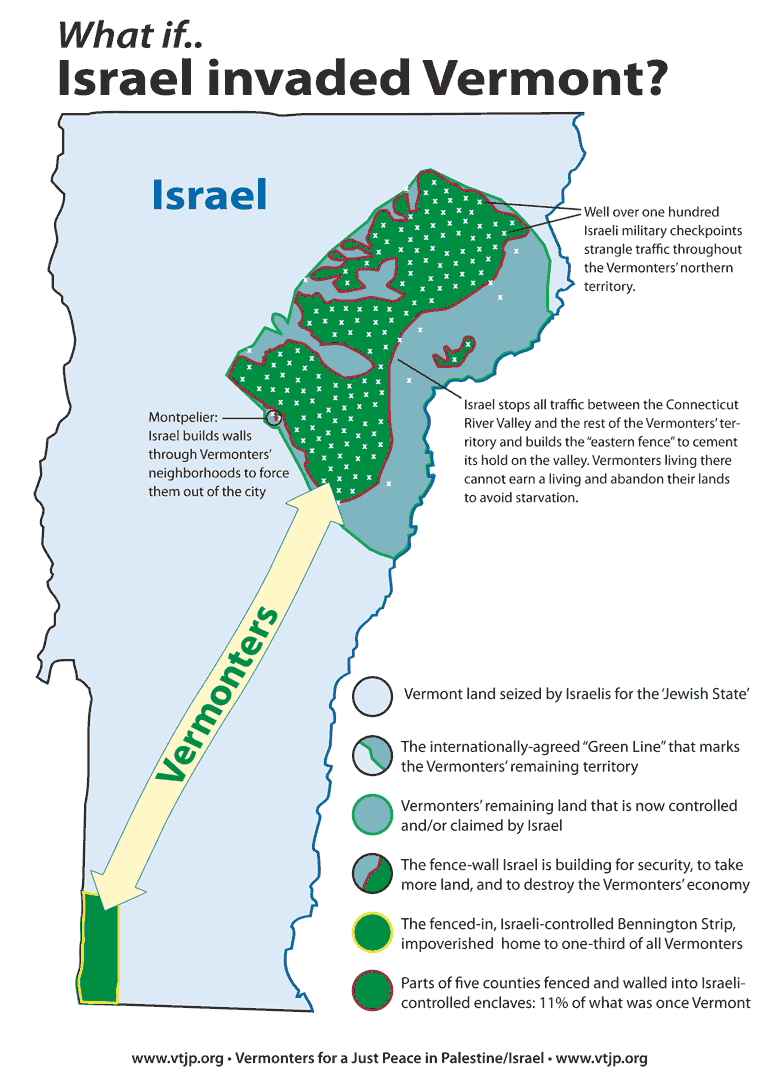
VTJP Mission Statement & Vermont Occcupation Map page 19
Acknowledgements page 20
Executive Summary
In 2011, Vermonters for a Just Peace in Palestine/Israel, with help from Jewish Israeli and Palestinian activists, conducted research into Ben & Jerry’s business practices and sales in the occupied Palestinian territories (oPt). Our investigation confirmed that this “values-based,” socially responsible company, headquartered in South Burlington, Vermont, has commercial ties to illegal Jewish settlements in the West Bank and East Jerusalem. Moreover, in 2010, as the occupation entered its 44th year and settlements expanded, the company opened a new factory and announced plans to expand the number of scoop shops.
Ben & Jerry’s operations in Israel and in illegal Jewish settlements make it economically complicit in the many crimes perpetrated by the Israeli government against the Palestinian people—land theft, dispossession, and home demolitions; the destruction of farm land and olive and fruit trees; arbitrary arrests and detentions; killings and acts of terror by soldiers and settlers; closures, curfews, checkpoints and a massive Separation Wall complex; separate roads and legal systems (one for Jews, the other for Arabs); the illegal expropriation of water and denial of the rights of Palestinian refugees. VTJP also suspects that the company’s factory in Israel may be supplied with diverted water from the largest aquifer in the West Bank, the Jordan River, or both.
Ben & Jerry’s Social Mission Cannot be Reconciled with Occupation & Colonialism
Ben & Jerry’s champions peace, economic justice and social equality, and defends family farms and the environment. It cannot be willfully blind to or profit from the injustices of Israel’s occupation and remain true to its social mission. Conservatively, an estimated 500,000 Israeli Jews are embedded in illegal, fortified settlements in the West Bank and East Jerusalem, and their numbers are growing. One of their many privileges is being able to buy Ben & Jerry’s ice cream from supermarket chains or have it delivered to their homes and social festivities by Ben & Jerry’s party carts. The ice cream comes to them from Ben & Jerry’s factory near Kiryat Malachi, a city inside Israel’s 1967 borders, which was founded on land forcibly taken from Palestinians in 1948.1
The company’s shops in Israel, like their American counterparts, scoop something sweet with a dollop of social consciousness. In this case, however, they are just a short drive from occupied Palestinian cities and villages, many of which have been economically crippled by closure policies, restrictions on movement and land confiscations. Israeli distributors of Ben & Jerry’s ice cream, on the other hand, send trucks routinely and with relative ease into the West Bank and East Jerusalem to service Jewish settlements. The same is true for the company’s party carts. Palestinians, however, must wait for hours, sometimes days, at military checkpoints. It is not uncommon for them to be humiliated, arrested, threatened, beaten and shot by soldiers at checkpoints or roadblocks, or to have their lives disrupted and curtailed by the daily activities of Jewish settlers. What does it say about Ben & Jerry’s and Israel that it is far easier for a Jewish settler to buy a pint of ice cream than it is for a Palestinian woman to get to work or bring her child to a doctor?
A Plea for Justice: From Occupied Palestine to Ben & Jerry’s in Vermont
VTJP’s nonviolent opposition to Ben & Jerry’s business dealings in Israel and the oPt is justified by the grave human right violations being committed by the Jewish state. We are also aware that Palestinian civil society, in 2005, called for a boycott, divestment and sanctions (BDS) campaign against Israel until it complied with three rights codified in international law:
1. Ending its occupation and colonization of all Arab lands and dismantling its Separation Wall complex;
2. Recognizing the fundamental rights of the Arab-Palestinian citizens of Israel to full equality; and
3. Respecting, protecting and promoting the rights of Palestinian refugees to return to their homes and properties as stipulated in United Nations Resolution 194.
VTJP made extensive efforts to communicate and meet with company executives. We deferred releasing this report for some time because we believed that Ben & Jerry’s should be given an opportunity to respond to our concerns and to take action commensurate with its social mission that would negate the need for public exposure. To our surprise, it took five letters from VTJP, the first of which was mailed in March, 2010, before Ben & Jerry’s CEO, Jostein Solheim, the Rob Michalak, Global Director of Social Mission, and Jeff Furman, President of the Board of Directors, agreed to a meeting at the company’s headquarters in April, 2012 (Mr. Furman, who lives in New York state, participated by telephone). Prior to this, communications with the company were limited to a brief telephone conversation between Mark Hage of VTJP and Rob Michalak, and a one-page letter from Jostein Solheim to Mr. Hage. In these communications, Ben & Jerry’s neither confirmed nor denied at the time that it was doing business in Jewish settlements in the oPt. Mr. Michalak, for his part, said he would look into the matter.
The meeting in April was frank, wide ranging and cordial. VTJP learned that contractual oversight of the Israeli franchise rests with Ben & Jerry’s in Vermont (not with Unilever), and that this contract was up for re-negotiation. It was our impression that Ben & Jerry’s was genuinely surprised to discover that their Israeli factory was catering to Jewish settlers with party carts. The company did not dispute our assertion that it was selling and marketing in the settlements, but asked for time to consider our information and their future options in respect to the franchise in Israel, which included potential ramifications under that country’s anti-boycott law should they decide to close the factory or prohibit sales to Jewish settlements. They also wanted to assess the impact of such decisions on their Israeli licensee, Avi Zinger, who has ties to company founder Ben Cohen and is held in high regard. Mr. Solheim consented as well to bring our concerns to their Board of Directors at that body’s May meeting in London. Beyond this, no assurances were given by the company, other than a commitment to meet with us after conferring with their Board. Subsequently, a second meeting was tentatively scheduled for July 19.
Six months later, in October-November, Jeff Furman, a long-time anti-racism activist, traveled to the West Bank and East Jerusalem with a delegation of American civil rights leaders. His decision to join the delegation, we believe, solidified after the April meeting. He met with Palestinian and Israeli anti-occupation and BDS activists and saw first-hand the consequences of more than 45 years of military occupation and settler colonization.2 VTJP was heartened by Mr. Furman’s trip to occupied Palestine and was impressed by his desire to learn more about the occupation. We had requested of the company, in fact, that it send its CEO, Board Directors and other management personnel to the oPt to assess the situation on the ground. VTJP was given to understand that Mr. Furman’s trip was a “personal” one—not formally undertaken on behalf of Ben & Jerry’s—but we hoped it would have a positive influence on our dialogue with the company.
Regrettably, the company cancelled our second meeting in July and failed to re-schedule it after Mr. Furman returned from Israel/Palestine. We were assured in April and thereafter in e-mail correspondence that another face-to-face meeting would occur. Mr. Furman said in one e-mail he was very interested in sharing with us what he learned on his trip. We do not understand why the second meeting did not transpire, beyond vague company references in the summer to “scheduling conflicts.” VTJP hopes the company will honor its commitment to meet with us again.
With no immediate prospect of action by the company or even discernible interest in continued engagement, VTJP is compelled now to bring the facts of Ben & Jerry’s economic involvement in Israel’s occupation and settlement regime to Vermonters and others in the United States, and to those outside our borders concerned about or engaged with the struggle for peace and justice in Israel/Palestine. To be clear, we are not calling for a boycott of Ben & Jerry’s at this time. Instead, we are calling on our fellow Vermonters and people of conscience everywhere to ask Ben & Jerry’s to do the following:
1. End the marketing and sale of Ben & Jerry’s products in all supermarkets, stores, restaurants, scoop shops, kiosks and social events in Jewish settlements in occupied East Jerusalem and the West Bank.
2. Stop manufacturing and selling ice cream in Israel until the military occupation and colonization of the Palestinian territories is terminated in strict compliance with international law.
VTJP also urges the company to send its CEO, head of its Global Mission office and a delegation of its Board of Directors to occupied Palestine to learn why it is morally and politically imperative that the company end commercial ties to Israel and its illegal settlement project until the occupation ends.
Part 1: Ben & Jerry’s in Israel and Occupied Palestine
In 2011, Vermonters for Just Peace in Palestine/Israel (www.vtjp.org) conducted a long investigation into the business practices of Ben & Jerry’s in Israel and the occupied Palestinian territories (oPt). This iconic company, much beloved in Vermont, produces premium ice cream and other dessert products. Additionally, it is a prominent leader of the “values-based” business movement, advocating for and funding a host of social, anti-war and environmental causes. Most recently, it has vigorously championed the national Occupy Wall Street Movement, which garnered substantial media attention. Our interest in Ben & Jerry’s in relation to Israel/Palestine was aroused when we learned that its parent company, Unilever, had been the target of a successful political campaign, based in the Netherlands, that prompted it to move a subsidiary operation from the West Bank to Israel proper. If Unilever is doing business in Israel and the oPt, we wondered, is it possible Ben & Jerry’s is as well?
In short order, VTJP discovered that Ben & Jerry’s had recently invested approximately $2 million to build a new ice cream plant near the southern Israeli city of Kiryat Malachi, about 12 miles west of Jerusalem, and had announced plans to open 16 ice-cream parlors and kiosks across the country.3 It surprised and disappointed us to learn that one of the world’s most socially conscious corporations was deepening its commercial activities in Israel as that country was intensifying its settler-colonial policies in East Jerusalem and the West Bank, and continuing to impose a brutal siege on Gaza. Ben & Jerry’s operations in Israel go back more than 20 years, and in a meeting with CEO Jostein Solheim, we were told that company headquarters in South Burlington (not Unilever) manages the business and contractual relationship with the Israeli franchise. Most disturbingly, field research in the oPt in the summer of 2011 by one of our members documented conclusively that the ice cream produced at Ben & Jerry’s Israeli factory is marketed, sold and catered to Jewish settlers in occupied East Jerusalem and the West Bank.
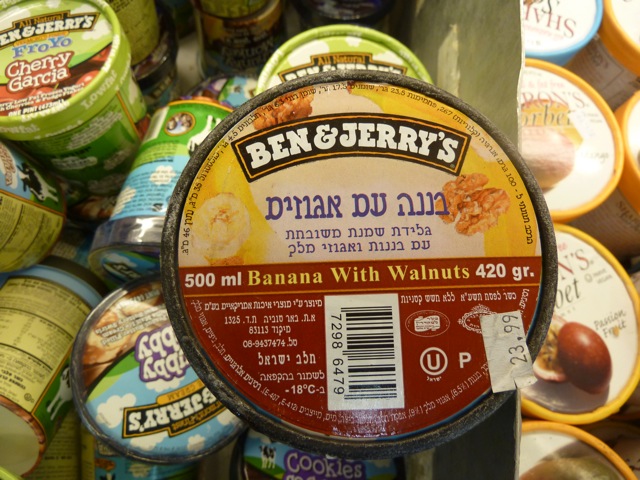
B&J ice cream on sale in the illegal Jewish settlement of
Gilo in the West Bank. (Photo by Kathy Shapiro, VTJP.)
2. Jewish Settlements, International Law & U.S. Foreign Policy
Israel’s settlement project in the Palestinian territories violates Article 49(6) of the Fourth Geneva Convention, which declares that “[t]he Occupying power shall not deport or transfer parts of its own civilian population into the territory it occupies.” 4 [emphasis added] The commentary to the Convention explains that this provision was intended “to prevent a practice adopted during the Second World War by certain powers, which transferred portions of their own population to occupied territory for political and racial reasons or in order, as they claimed, to colonize those territories. Such transfers worsened the economic situation of the native population and endangered their separate existence as a race.”5
The transfer of settlers to occupied territory by an occupying power is also an international war crime under Article 8(2)(b)(viii) of the 1998 Rome Statute of the International Criminal Court.6 Moreover, the UN Security Council and General Assembly, the High Contracting Parties to the Geneva Conventions, the International Committee of the Red Cross, and most legal scholars have concluded that Israel’s settlements in the oPt contravene international law.7 The International Court of Justice declared in a 2004 decision that “…the Israeli settlements in the Occupied Palestinian Territory (including East Jerusalem) have been established in breach of international law.”8
Israel’s settlements in the oPt, populated by approximately 500,000 Jews, are also at odds with official U.S. foreign policy, despite billions of dollars annually in American military aid to Israel. Between 1967 and 1980, the Johnson, Nixon, Ford and Carter administrations asserted that the settlements were in violation of the Fourth Geneva Convention; subsequent administrations, beginning with Ronald Reagan in 1981, backed away from public utterances that accent the illegality of the settlements, but expressed opposition to them in varying degrees and described them as impediments to diplomacy and peace negotiations.9 More recently, our current U.N. Ambassador, Susan Rice, said, “…we reject in the strongest terms the legitimacy of continued Israeli settlement activity.”10
The settlements are a central feature of what a distinguished team of legal scholars have characterized as “Israel’s grand policy to fragment the oPt for the purposes of segregation and domination. This policy is evidenced by: Israel’s extensive appropriation of Palestinian land, which continues to shrink the territorial space available to Palestinians; the hermetic closure and isolation of the Gaza Strip from the rest of the OPT; the deliberate severing of East Jerusalem from the rest of the West Bank; and the appropriation and construction policies serving to carve up the West Bank into an intricate and well-serviced network of connected settlements for Jewish-Israelis and an archipelago of besieged and non-contiguous enclaves for Palestinians.”11
Human Rights Watch reported in 2010 that Israel’s discriminatory policies in the occupied territory appear to be for the purpose of “promoting life in the settlements while in many instances stifling growth in Palestinian communities and even forcibly displacing Palestinian residents. Such different treatment, on the basis of race, ethnicity, and national origin and not narrowly tailored to meet security or other justifiable goals, violates the fundamental prohibition against discrimination under human rights law.”12 Violent attacks by settlers against Palestinians are a daily or near daily occurrence, averaging 2.6 per day in 2011. According to a study released by the Palestine Center in February, 2011, settler attacks between 2007 and 2011 increased by 315%.13 The most common forms of settler violence in 2011 were arson, stone throwing, shootings, vehicular attacks and physical assaults, with a noticeable increase in fires set to Palestinian property.14
Ben & Jerry’s trumpets a broad, progressive social mission dedicated to meeting human needs and eliminating injustices. It is impossible to reconcile this mission with business practices in illegal Jewish settlements in the oPt. These practices contravene the United Nation’s “Norms on the Responsibilities of Transnational Corporations and Other Business Enterprises,” which dictates that corporations “shall not engage in nor benefit from war crimes, [or] crimes against humanity…,”15 or take actions that obstruct or impede economic, social, cultural, civil and political rights?16 Further, Ben & Jerry’s admirable support for peace initiatives and Occupy Wall Street17 is sorely compromised by investing, manufacturing and selling in a country that is orchestrating the violent dispossession of the Palestinian people, the theft and colonization of their ancestral lands, and the expropriation of their water sources.

Supermarket clerk with a pint of B&J ice cream,
in the illegal settlement of Gilo in the West
Bank. (Photo by Kathy Shapiro, VTJP.)
3. Ben & Jerry’s Business in Illegal Jewish Settlements
Kathy Shapiro makes her home in Montpelier, Vermont, and is affiliated with VTJP. She lived in occupied East Jerusalem from May to November, 2011. With assistance from Jewish Israeli peace activists and a Palestinian compatriot, she investigated the sale of Ben & Jerry’s products in illegal Jewish settlements in East Jerusalem and the West Bank. Thanks to her efforts, VTJP learned that Ben & Jerry’s ice cream is for sale in some Jewish settlements. We do not know yet the full scope of this enterprise or for how long it has been going on. But thanks to Ms. Shapiro, we can safely speculate that Ben & Jerry’s products are found, at the very least, in large, well-established Jewish settlements. We hope one day that Ben & Jerry’s will shed more light on their business in the oPt—how extensive it is, the money it earns, how it is managed, special tax breaks or other inducements their licensee may receive for contracting with venues in the settlements, why and when they sanctioned it, and who in the company authorized it.
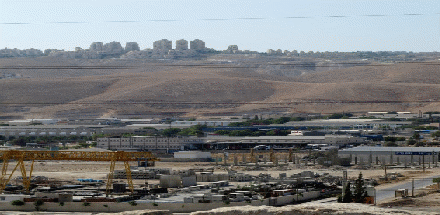
A view of the Mishor Edomim Industrial Park and the Ma’aleh Adumim
Jewish settlement above it. (Photo: Esti Tsal, Who Profits, Israel.)
Shapiro’s travels in occupied Palestine took her to the illegal Jewish settlements of Gilo (pop. 28,980) and Pisgat Ze’ev (pop. 39,748) in occupied (Greater) East Jerusalem, to Ma’ale Adumim (pop. 35,673), the third largest Jewish settlement in the West Bank,18 and to the industrial park of Mishor Edomim, which services Ma’ale Adumim. A map of the central West Bank and East Jerusalem on page 18 identifies the location of these settlements.
Shapiro visited settlement supermarkets and purchased Ben & Jerry’s ice cream. She kept receipts, and photographed pints of B&J ice cream and the supermarkets where they are sold. She also took pictures of Palestinian Bedouin encampments under constant threat of demolition in the vicinity of the settlements, and of olive groves that had been cut down—only stumps remain—to accommodate Jewish settlements and Israeli occupation forces. At Ms. Shapiro’s behest, an Jewish Israeli activist—we’ll call this person “R”—contacted Ben & Jerry’s headquarters in Israel by e-mail and telephone, and confirmed that it would deliver ice cream directly to the Jewish settlement of Ma’ale Adumim deep in the West Bank. (Because of a 2011 Israeli law that exposes activists like “R” to civil charges and damages for supporting BDS initiatives, we cannot divulge this individual’s name. The e-mail correspondence between this person and a Ben & Jerry’s employee, translated from Hebrew by “R,” is found on page 17.)
Shapiro and “R’s” investigations prove categorically that Ben & Jerry’s is pursuing market share and making money in illegal Jewish settlements.

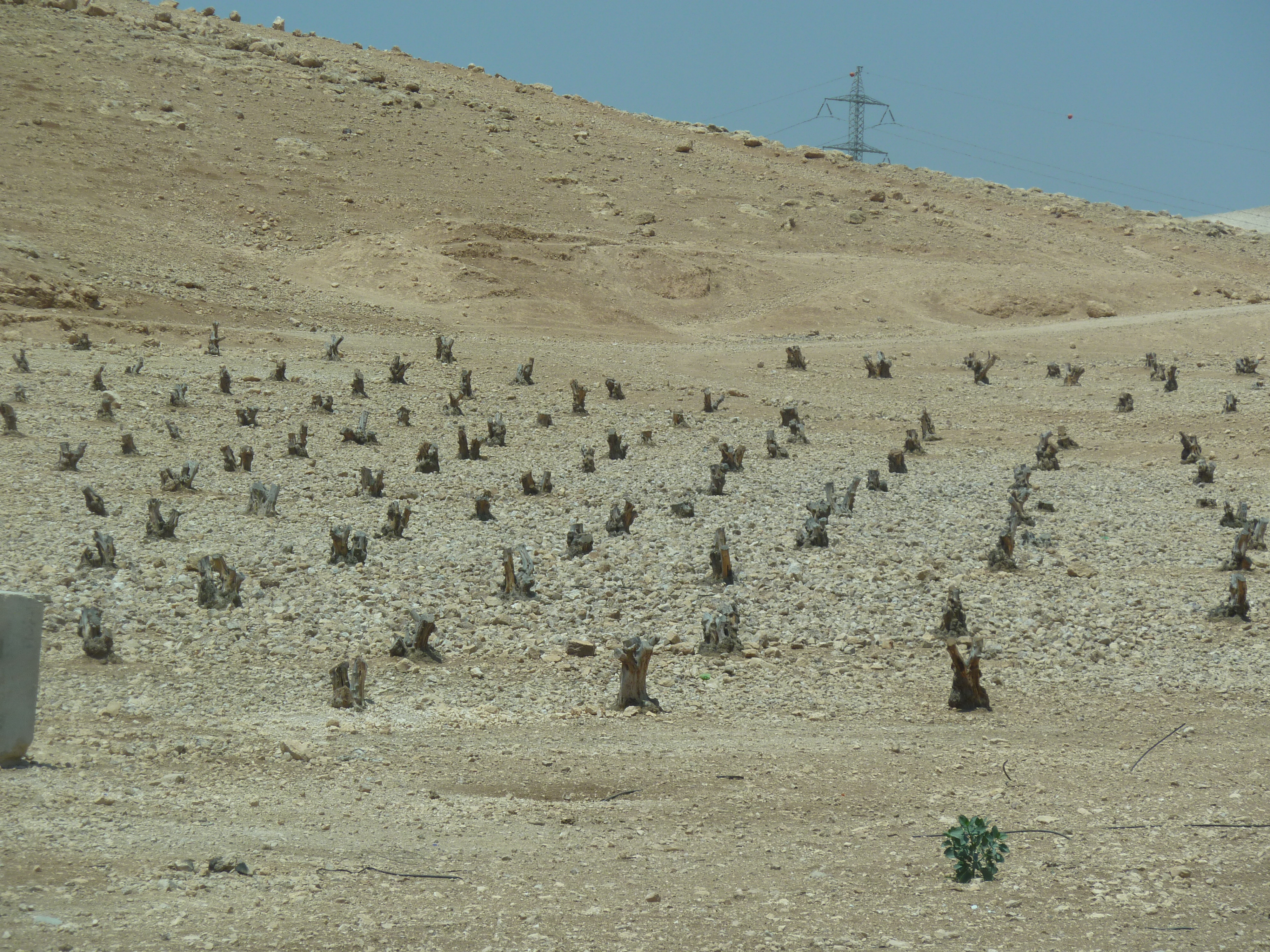
Palestinian olive grove cut down by Israeli Occupation Forces near the illegal Jewish
settlement of Ma’ale Adumim. (Photo by Kathy Shapiro, VTJP.)
4. Ben & Jerry’s Factory in Israel and the Theft of Palestinian Water
Ben & Jerry’s factory near Kiryat Malachi opened officially in June, 2010.19 To understand how and from where water makes its way to the plant, VTJP set out to decipher Israel’s water distribution system, as well as the laws and military regulations employed to divert Palestinian water to the state’s purposes, both in the oPt and within its pre-1967 borders. Our inquiry led us to the tentative conclusion that the factory may be drawing water from (a) the Jordan River system—in particular, the Sea of Galilee—and (b) the Mountain Aquifer in the West Bank, the highest-quality water sources in the region, thus diverting it from Palestinian use.
Water abstraction and allocation for Israel and the oPt is managed by the Israeli public company Mekorot, which operates more than 40 wells inside the West Bank, as well managing the country’s national water carrier (NWC). Most of these wells are in the Jordan Valley and supply Jewish settlements.20 But Mekorot also operates hundreds of deep wells along Israel’s side of the “Green Line,” the country’s pre-1967 border.21 Maps of the NWC (one is reprinted on page 17) show plainly that water from the Mountain Aquifer in the West Bank is dumped into these wells. It is then channeled south to Israeli communities, including, perhaps, Kiryat Malachi.22
Susan Koppleman, an international water consultant and co-author of the report “The Human Right to Water in Palestine,” told VTJP she felt confident saying that Kiryat Malachi is “very likely” drawing some water from the West Bank. The city may be getting water also, she said, from two other sources, the Sea of Galilee and Ashkelon, a city in the Negev with a desalination plant. The Sea of Galilee is a possible source, despite its great distance from Kiryat Malachi, because it is the NWC’s “primary natural reservoir, and provides water to Israel’s dense population centers as well as to the South.”23
Denied access to the Jordan River, the Mountain Aquifer is the Palestinians only source of water. A study by The World Bank determined that “Palestinian per capita access to water resources in the West Bank is a quarter of Israeli access and is declining.”24 This pattern is no accident, but a result of Israeli government planning and regulation.25
To make matters worse, Israeli settlers in the West Bank often obstruct or disconnect the flow of water to Arab communities, while “consuming approximately six times the water consumed by some three million Palestinians. This amount is even higher when use for agricultural purposes is factored in.”26 Regular access to water explains green lawns and swimming pools in Jewish settlements. In stark contrast, throughout the year, but especially in the summer, “[The] supply of water to Palestinian cities and villages is not continuous…and Palestinians can go without water for weeks on end.”27 This injustice is aggravated by Israel’s policy of denying permits to Palestinians to drill new wells or rehabilitate old ones.28
By manufacturing in Israel and marketing in the oPt, Ben & Jerry’s is a partner to a water system that is grossly inequitable, violates international law, and denies Palestinians their fair share of the Mountain Aquifer and the Jordan River.
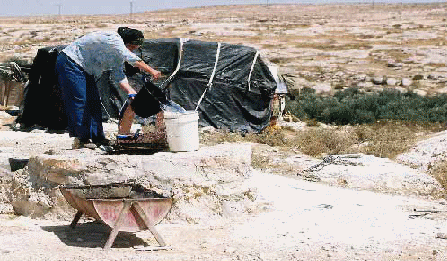
“Water is life; without water we can’t live; not us, not the animals, or the plants. Before we had some water, but after the army destroyed everything we have to bring water from far away;… They make our life very difficult, to make us leave. The soldiers first destroyed our homes and the shelters with our flocks, uprooted all our trees, and then they wrecked our water cisterns. These were old water cisterns, from the time of our ancestors. Isn’t this a crime? -- Fatima al-Nawajah, a resident of Susya, a Palestinian village in the South Hebron Hills, in the West Bank, to Amnesty International, April 2008.
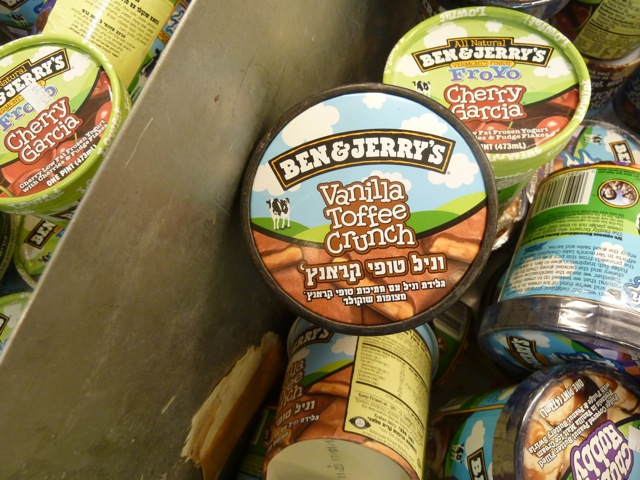
Ben & Jerry’s ice cream in a market in the Jewish settlement
of Gilo, in the West Bank. (Photo by Kathy Shapiro, VTJP.)
5. A Time to Act
The news portal Electronic Intifada published an update on boycott, divestment and sanctions (BDS) initiatives worldwide against Israel’s occupation in July, 2011. It included this report on Ben & Jerry’s parent company, Unilever, and business by one of its subsidiaries in the oPt:
“On 19 July [2011], the multinational corporation Unilever, after unsuccessfully attempting to sell its shares in the company, formally announced plans to move its Bagel and Bagel pretzel factory from the Barkan industrial zone in the Ariel settlement bloc [in the oPt] to within the green line, Israel’s internationally-recognized armistice line with the occupied West Bank29
Ben & Jerry’s should draw inspiration from Unilever’s example and terminate sales and catering services in Jewish settlements in the occupied territories. It should also take the bold measure of stopping production at its Israeli factory and closing its scoop shops in Israel until the occupation ends and a just peace is negotiated in conformance with international law. Manufacturing ice cream in Israel and selling it in Jewish settlements legitimizes the occupation and “normalizes” life for Jewish settlers. Israeli Jews who live in racially exclusive communities on stolen land—as well as those within Israel proper who politically support, defend and financially subsidize the settlements—should not have the privilege of purchasing Ben & Jerry’s ice cream while Palestinians are under siege in occupied Gaza and oppressed by soldiers, concrete walls, and checkpoints in the West Bank and East Jerusalem, forbidden their daily bread and rightful allotment of water, and denied the right to self-determination. Ben & Jerry’s stands, it says, for everyone getting a fair deal. That commitment, if true, should include Palestinians as well as Jewish Israelis.
Based on what VTJP was told at its meeting with company executives last April, Ben & Jerry’s has the contractual authority to cut off sales in illegal Jewish settlements and to end the franchise in Israel. These actions would send a powerful message to the governments of Israel and the United States, and to other international businesses complicit in the occupation. Moreover, they would be consistent with the company’s desire to be a force for positive change in the world, as reflected in these comments by CEO Solheim:
“The world needs dramatic change to address the social and environmental challenges we are facing. Values led businesses can play a critical role in driving that positive change. We need to lead by example, and prove to the world that this is the best way to run a business. Historically, this company has been and must continue to be a pioneer to continually challenge how business can be a force for good and address inequities inherent in global business."30
Vermonters for a Just Peace in Palestine/Israel calls on Ben & Jerry’s founders, managers and Board of Directors to be true to the company’s social mission and business values, and we ask our fellow Vermonters and people of conscience around the world to join us in asking the company to:
1. End the marketing and sales of its products in all supermarkets, stores, restaurants, scoop shops, kiosks and social events in illegal Jewish settlements in occupied East Jerusalem and the West Bank.
2.
Stop manufacturing and selling ice cream in Israel until the military
occupation and colonization of the Palestinian territories is
terminated in strict compliance with international law.
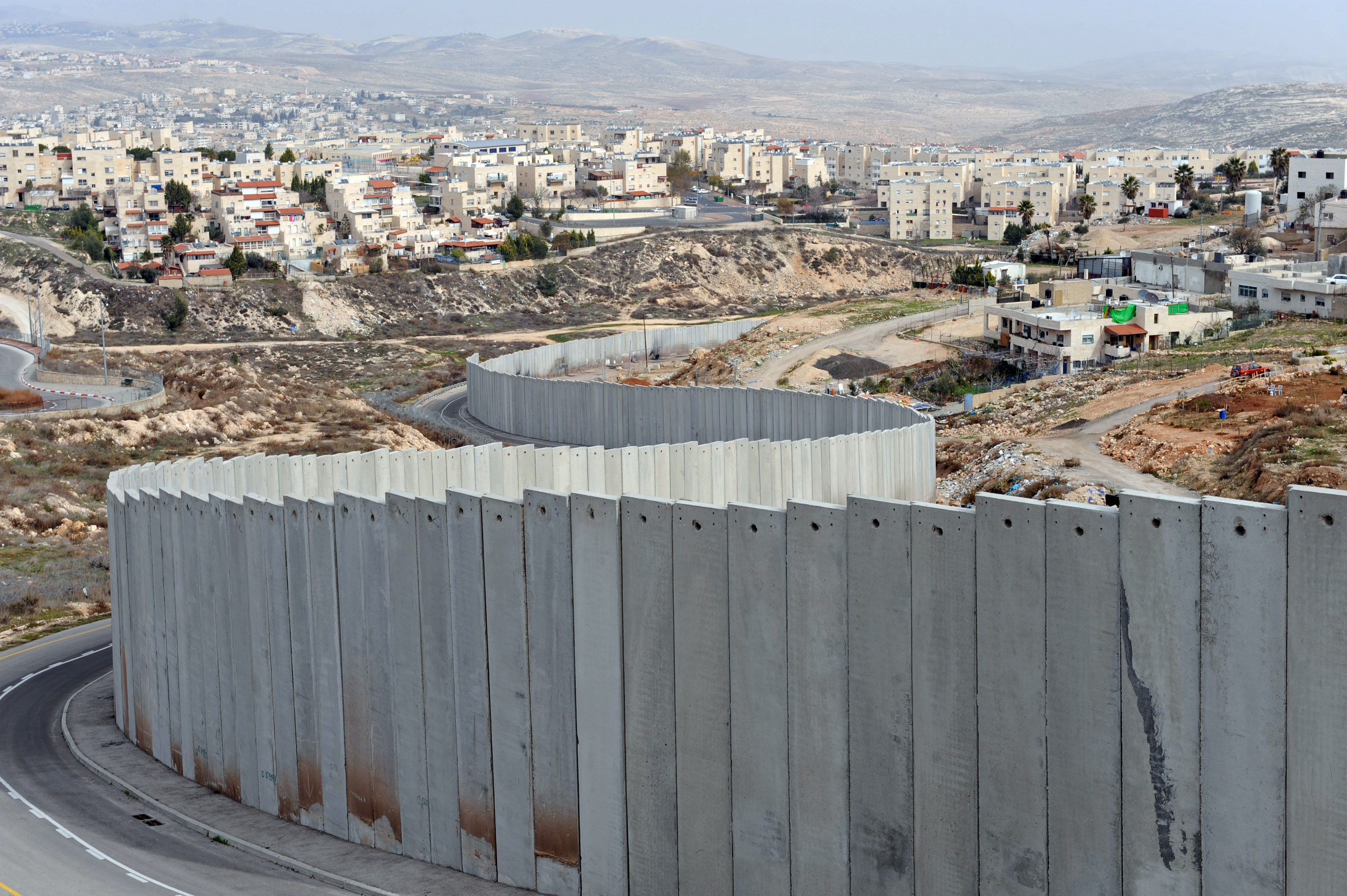 Jewish
settlement of Pisgat Ze’ev in the foreground and the illegal
Separation Wall. The Shuafat refugee camp is to the right of the
wall
(http://www.thirdage.com/news-photo/israeli-separation-wall-divides-shuafat-refugee-ca/56224).
Jewish
settlement of Pisgat Ze’ev in the foreground and the illegal
Separation Wall. The Shuafat refugee camp is to the right of the
wall
(http://www.thirdage.com/news-photo/israeli-separation-wall-divides-shuafat-refugee-ca/56224).
Appendices

Ben & Jerry’s: Progressive EXCEPT for Palestine?
For this section, we drew information from Ben & Jerry’s website (www.benjerry.com), much of it from the company’s 2011 “Social & Environmental Assessment Report” (http://www.benjerry.com/company/sear-reports/sear-2011). An English translation of the website for the company’s franchise in Israel is not available online, to the best of our knowledge. The Hebrew-language website can be accessed at: http://www.benjerry.co.il/.
Introduction
Ben & Jerry’s is based in South Burlington, Vermont, and was founded by Ben Cohen and Jerry Greenfield. They opened their first scoop shop in Burlington, Vermont, in 1978. Today, the company’s ice cream and novelties are sold across the United States, and in more than 30 other countries. There is a long-standing franchise in Israel, managed by a licensee named Avi Zinger. In addition to shops and sales in Israel proper, the Israeli franchise markets, caters and sells in illegal Jewish settlements in the occupied Palestinian territories (oPt) of the West Bank and East Jerusalem. There is no mention of the company’s commercial transactions in the oPt on its English-language website or in the annual SEAR.
Operations
The company’s ice cream is made in three factories in the United States: two in Vermont (Waterbury and St. Albans); the third in Henderson, Nevada. The company’s U.S. frozen novelties are produced in Sikeston, Missouri. Abroad, its ice cream is produced in two Unilever facilities, one in Hellendoorn, The Netherlands, the other in Simcoe, Ontario. A third international plant opened in 2010, in Be’er Tuvia, Israel, near the city of Kiryat Malachi. The 2011 SEAR document does not reference the plant in Israel. The company’s first factory in Israel, according to reports in the Israeli media, was located in the city of Yavne. It closed several years ago when it did not meet export standards. At the close of 2011, the company employed 442 people globally. An additional 200 employees were employed at the Unilever plant in The Netherlands, and 35 others (amounting to 15 FTEs) were also employed by Unilever on behalf of marketing and selling and providing other services for the B&J brand.
Governance
The 2011 SEAR describes the company’s governance structure, briefly, as follows: “Ben & Jerry’s global business is managed out of our Central Support office in South Burlington, Vermont. Within Unilever, we are grouped with the Breyers®, Klondike®, Popsicle® and Good Humor® brands in the U.S. Ice Cream division, managed out of Englewood Cliffs, New Jersey.” Its CEO is Jostein Solheim, a veteran manager of Unilever. The company also has an independent Board of Directors, which meets quarterly, and is charged with “…advising and supporting Ben & Jerry’s senior management in maintaining and strengthening the Company’s three-part Mission Statement and protecting Ben & Jerry’s brand equity.” In 2011, the Board also “had important input on the Company’s support for the Occupy movement, Ben & Jerry’s Fair Trade strategy, Business for Democracy initiative, and numerous other issues.”
Mission
The company articulates its mission in three parts:
Product Mission To make, distribute and sell the finest quality all natural ice cream and euphoric concoctions with a continued commitment to incorporating wholesome, natural ingredients and promoting business practices that respect the Earth and the Environment.
Economic Mission To operate the Company on a sustainable financial basis of profitable growth, increasing value for our stakeholders and expanding opportunities for development and career growth for our employees.
Social Mission To operate the company in a way that actively recognizes the central role that business plays in society by initiating innovative ways to improve the quality of life locally, nationally and internationally.
Ben & Jerry’s overarching mission is girded to “the determination to seek new and creative ways of addressing all three parts, while holding a deep respect for individuals inside and outside the company and for the communities of which they are a part.”
In respect to its social mission, the company is dedicated to three goals: (1) Furthering the cause of peace and justice; (2) Making ice cream aligned with its values; and (3) Promoting global sustainable dairy practices.
Progressive Business Values
Under a banner on its website that reads, “Leading with Progressive Values across our Business,” we find these laudable words, among others:
We have a progressive, nonpartisan social mission that seeks to meet human needs and eliminate injustices in our local, national and international communities by integrating these concerns into our day-to-day business activities. Our focus is on children and families, the environment and sustainable agriculture on family farms
We seek and support nonviolent ways to achieve peace and justice. We believe government resources are more productively used in meeting human needs than in building and maintaining weapons systems.
We strive to show a deep respect for human beings inside and outside our company and for the communities in which they live.
Ben & Jerry’s Foundation & Commitment to Social Activism
The Ben & Jerry’s Foundation awards grants to “grassroots activists making positive change in their own communities.” It channels its resources to helping “immigrant workers, neighborhood groups, farm workers and dozens of other groups around the country to get organized and fight for a fair deal.” The company contributed $2,180,808 to its Foundation in 2011. Additionally, it paid royalties to nonprofits worldwide totally $1,998,103. The company also invests, financially and through employee-donated time, in community action projects and social mission campaigns. In 2011, it tallied its total global investment “in the community through nonprofit royalties, community action, social mission campaigns, and charitable giving (not including the Ben & Jerry’s Foundation)” at more than $2,436,000. On a scale of 1 to 5, where 1 represents “strongly disagree” and 5 represents “strongly agree,” the statement “The Social Mission is important to Ben & Jerry’s success as a business” received an average score of 4.1 from the company’s workers.

B&J ice cream in Mishor Adumim, which is
near the settlement of Ma’ale Adumim.
(Photo by Kathy Shapiro, VTJP)
E-Mail Correspondence between Jewish-Israel Activist (“R”) & a Ben & Jerry’s Employee (“Q”) in Israel
Three e-mails below, dated August 2 and 3, 2011, between a Jewish-Israeli activist named “R,” and an employee at Ben & Jerry’s factory in Israel, identified as “Q,” pertain to an undercover investigation instigated by VTJP into the practice of sending Ben & Jerry’s ice cream carts to Jewish settlements in the West Bank. In this particular case, to Ma’ale Adumim, the third largest in the oPt, which Kathy Shapiro of VTJP visited.
August 02, 2011 9:51 a.m.
R. Shalom,
Thanks for writing. Our ice cream cart comes with 5 flavors to choose from, glasses, wafers, ice cream toppings, 2 stewards and all accessories. The cost for 250 people (free distribution) – 3,500 [NIS (Israeli Shekels), or $919 US] including VAT.
Attached is a list of flavors. I’ll be happy to answer any questions.
Sincerely,
Q
August 02, 2011 11:57 a.m.
Q Hello,
Is there an extra cost that relates to the distance of your factory to the location of the party? i.e., [sic]
is there an extra cost because the event is held in Ma’ale Adumin?
I’m sorry about the need for detail, but it’s necessary for our accounting department.
Thank you and good day.
R.
August 2, 2011 13:02
Hey R,
Yes the cost of transportation is 250 [NIS (Israeli Shekels), $65 US]. This is because we come from Be’er Tuvia (near Kiryat Malachi) to Maale Adumim.31
T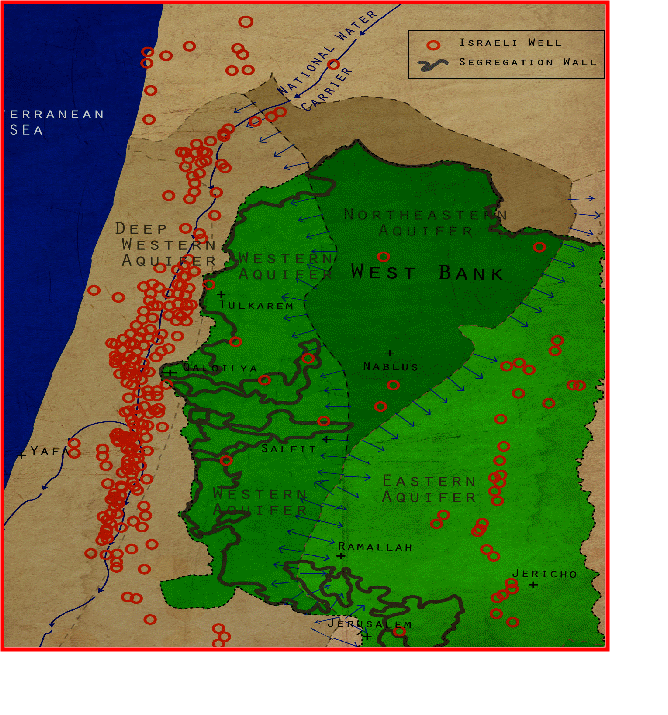 rajectory
of Israel’s
National Water Carrier & Location of Wells
rajectory
of Israel’s
National Water Carrier & Location of Wells
The network of wells to the east of Israel’s 1967 border captures water from the Mountain Aquifer in the occupied West Bank and directs it to Israeli communities. From: “The Human Right to Water in Palestine,” published by LifeSource. It can be accessed at http://www.blueplanetproject.net/documents/RTW/RTW-Palestine-1.pdf.
Location of Jewish Settlements in the West Bank & East Jerusalem
Visited by Kathy Shapiro
The map below captures a section of the Israeli-occupied West Bank and East Jerusalem. The Jewish settlements marked with a red star—Pisgat Ze’ev, Ma’ale Adumim, Mishor Adumim and Gilo—were visited by VTJP member Kathy Shapiro in 2011. The broken “green line” is Israel’s 1948/1967 border; the broken “blue line” represents the expanded municipal borders of Jerusalem, which Israel imposed on the territory in 1967 as a prelude to its illegal annexation of East Jerusalem.
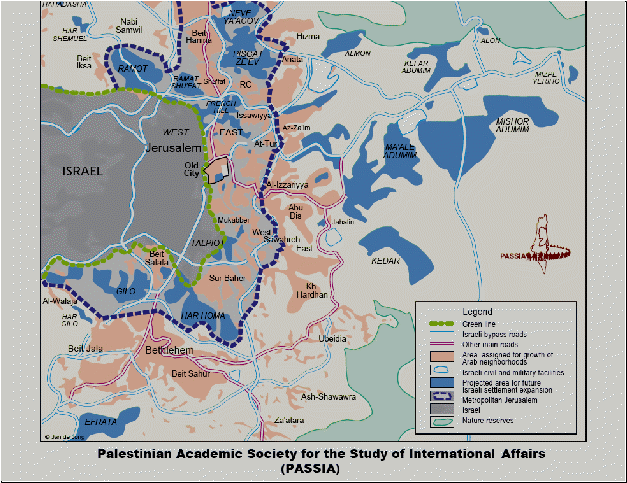


Source of map:
http://www.passia.org/palestine_facts/MAPS/images/jer_maps/Projectedgrowth.pdf
M
Vermonters for a Just Peace in Palestine/Israel works to support the survival of the Palestinian people and to end the illegal, immoral, and brutal Israeli occupation through education, advocacy, and action. We are committed to the principles of self-determination for the Palestinian people, the right of return for Palestinian refugees, and full civil and political rights for all Palestinians in order to promote the equality and safety of both Palestinians and Israelis.
The
organization supports the 2005 Call by Palestinian Civil Society for
an international campaign of boycott, divestment and
sanctions—BDS—against the state of Israel. For more
information, e-mail
Acknowledgements
Vermonters for a Just Peace in Palestine/Israel is deeply grateful to…
Kathy Shapiro, who lived and traveled in the occupied Palestinian territories for several months in 2011, and a Palestinian activist whose identity we are not at liberty to reveal, who provided translation and transportation services to Ms. Shapiro.
A committed group of Jewish Israelis, especially “R,” who assisted Kathy Shapiro, but must go unnamed to shield them from potential retribution by Israel’s government and Jewish settler organizations.
Omar Barghouti and the Palestinian Boycott, Divestment & Sanctions National Committee (www.bdsmovement.net). And our Palestinian brothers and sisters in the occupied territories, in Israel and throughout the world for their courage and steadfastness.
Vermont activists Ian Stokes, Walter Hergt, Hilary Martin, Jamie Brooks, Lauren Kael, Wafiq Faour, Debra Stoleroff, Marc Estrin, Mousa and Kris Ishaq-Petersen, Mark Hage, Helen Scott and Nolan Rampy, and the Steering Committee of VTJP.
The organizations Jewish Voice for Peace (www.jewishvoiceforpeace.org) and Who Profits (www.whoprofits.org).
Hannah Mermelstein and Riham Barghouti, BDS activists with Adalah-NY: The New York Campaign for the Boycott of Israel (www.adalahny.org).
Matt Ross and Jimmy Leas of the National Lawyers Guild.
Susan Koppleman of LifeSource (www.lifesource.ps), international water consultant.
All those, past and present, in Israel-Palestine and elsewhere, who have illuminated the path of nonviolent resistance to injustice embodied in campaigns of boycott, divestment and sanctions.
1 Kiryat Malachi, like most Israeli villages and towns, was established on lands formerly belonging to Palestinians forcibly dispossessed and exiled during the War of 1948. At least 750,000 Palestinians were made refugees by the war’s end. Kiryat Malachi is located on lands that were owned and cultivated by the Palestinians of Qastina in southern Palestine. The village was occupied in July, 1948, by Jewish militia, and its inhabitants driven out, mostly likely towards Gaza. After Qastina was destroyed in 1949 (along with hundreds of other Palestinian villages), Israel established the first of four Jewish communities on its lands. Kiryat Malachi was founded in 1951. For more on the history, conquest and destruction of Qastina and what followed, see All That Remains: The Palestinian Villages Occupied and Depopulated in 1948, edited by Walid Khalidi, The Institute of Palestine Studies, 1992, pgs. 130-31.
2 Alice Rothchild, an American-Jewish physician and member of the delegation to occupied Palestine with Ben & Jerry’s Board President, Jeff Furman, wrote about what participants saw and experienced. You can access her account at http://www.alternet.org/world/jewish-only-communities-imprisoned-palestinians-what-african-american-delegation-witnessed.
3 “Ben & Jerry’s to open new factory in Be’er Tuvia,” Y-Net News.com, 03.02.10, at http://www.ynetnews.com/articles/0,7340,L-3855584,00.html.
4“Convention (IV) Relative to the Protection of Civilian Persons in Time of War. Geneva,” 12 August 1949, at http://www.icrc.org/ihl.nsf/FULL/380?OpenDocument.
5 “Convention (IV) Relative to the Protection of Civilian Persons in Time of War. Geneva,” 12 August 1949, Commentary on Article 49, Paragraph 6. “Deportation and Transfer of Persons into Occupied Territories,” at http://www.icrc.org/ihl.nsf/COM/380-600056?OpenDocument.
6 “Rome Statute of the International Criminal Court, Part 2: Jurisdiction, Admissability and Applicable Law, Article 8(2)(b)(viii),” at http://untreaty.un.org/cod/icc/statute/romefra.htm.
.
7 “Occupation, Colonialism, Apartheid? A reassessment of Israel’s practices in the occupied Palestinian territories under international law,” Human Sciences Research Council of South Africa, page 89.
8 “Legal Consequences of the Construction of a Wall in the Occupied Palestinian Territory,” International Court of Justice, at
http://www.icj-cij.org/docket/files/131/1671.pdf, paragraph 120, page 184.
9 “Statements on American Policy toward Settlements by U.S. Government Officials – 1968-2009,” Matt Skarzynski, Jonathan H. van Melle, Foundation for Middle East Peace, and Holly Byker, Churches for Middle East Peace, June 8, 2009, at http://www.fmep.org/analysis/analysis/israeli-settlements-in-the-occupied-territories.
10 See full text of Ambassador Susan Rice’s speech, at http://usun.state.gov/briefing/statements/2011/156816.htm.
11 “Occupation, Colonialism, Apartheid? A reassessment of Israel’s practices in the occupied Palestinian territories under international law,” Human Sciences Research Council of South Africa, page 21.
12 “Separate But Unequal: Israel’s Discriminatory Treatment of Palestinians in the Occupied Palestinian Territories,” Human Rights Watch, 2010, at http://www.hrw.org/en/reports/2010/12/19/separate-and-unequal, page 6.
13 “When Settlers Attack,” Yousef Munayyer, The Palestine Center, at http://www.thejerusalemfund.org/ht/a/GetDocumentAction/i/32678, page 2.
14 “When Settlers Attack,” Yousef Munayyer, The Palestine Center, at http://www.thejerusalemfund.org/ht/a/GetDocumentAction/i/32678, pages 5-6.
15 “Norms on the responsibilities of transnational corporations and other business enterprises with regard to human rights,” at http://www.globalpolicy.org/images/pdfs/08ecosocnorms.pdf, page 4.
16“Norms on the responsibilities of transnational corporations and other business enterprises with regard to human rights,” at http://www.globalpolicy.org/images/pdfs/08ecosocnorms.pdf, page 5.
17“Ben & Jerry’s Becomes First High-Profile Company to Support Occupy Wall Street,” by Carmel Lobello, at http://www.deathandtaxesmag.com/149476/ben-jerrys-becomes-first-high-profile-company-to-support-occupy-wall-street/.
18 “Settlement Information: Statistics and Table,” Foundation for Middle East Peace, at http://www.fmep.org/settlement_info/settlement-info-and-tables/stats-data/settlements-in-the-west-bank-1; http://www.fmep.org/settlement_info/settlement-info-and-tables/stats-data/settlements-in-east-jerusalem; & http://www.fmep.org/settlement_info/settlement-info-and-tables/stats-data/comprehensive-settlement-population-1972-2006.
19“Grapevine; Two Firsts for HU,” 07/02/10, The Jerusalem Post, at http://www.jpost.com/LocalIsrael/InJerusalem/Article.aspx?id=180170.
20“Trouble Waters-Palestinians Denied Fair Access to Water,” Amnesty International, at http://www.ewash.org/files/library/mde150272009en.pdf, page 15.
21“The Human Right to Water in Palestine,” Susan Koppleman and Zayneb Alshalafeh, LifeSource, http://www.blueplanetproject.net/documents/RTW/RTW-Palestine-1.pdf, page 7.
22 Map of Israel’s National Water Carrier and network of wells east of the Green Line, published in “The Human Right to Water,” Susan Koppleman and Zayneb Alshalafeh, LifeSource, http://www.blueplanetproject.net/documents/RTW/RTW-Palestine-1.pdf, page 7.
23“Israel’s Water Supply System,” Mekorot: Israel’s National Water Carrier, at http://www.mekorot.co.il/Eng/Mekorot/Pages/IsraelsWaterSupplySystem.aspx.
24“West Bank and Gaza Assessment of Restrictions on Palestinian Water Sector Development,” Sector Report 2009, The World Bank, at http://www.phg.org/data/files/publications/general_reports/Reports/2009/worldbank_09.pdf, page 9.
25 “Joint Parallel Report submitted by the Emergency Water, Sanitation and Hygiene group (EWASH) and Al Haq to the Committee on Economic, Social and Cultural Rights on the occasion of the consideration of the Third Periodic Report of Israel, Israel’s violations of the International Covenant on Economic, Social and Cultural Rights with regard to the human rights to water and sanitation in the Occupied Palestinian Territory,” September, 2011, at http://www.ewash.org/files/library/110818%20EWASH%20Parellel%20Report%20to%20CESCR%20(2011)%20(FINAL).pdf, pages 6-7.
26 “Joint Parallel Report submitted by the Emergency Water, Sanitation and Hygiene group (EWASH) and Al Haq to the Committee on Economic, Social and Cultural Rights on the occasion of the consideration of the Third Periodic Report of Israel, Israel’s violations of the International Covenant on Economic, Social and Cultural Rights with regard to the human rights to water and sanitation in the Occupied Palestinian Territory,” September, 2011, at http://www.ewash.org/files/library/110818%20EWASH%20Parellel%20Report%20to%20CESCR%20(2011)%20(FINAL).pdf, page 9.
27 “Joint Parallel Report submitted by the Emergency Water, Sanitation and Hygiene group (EWASH) and Al Haq to the Committee on Economic, Social and Cultural Rights on the occasion of the consideration of the Third Periodic Report of Israel, Israel’s violations of the International Covenant on Economic, Social and Cultural Rights with regard to the human rights to water and sanitation in the Occupied Palestinian Territory,” September, 2011, at http://www.ewash.org/files/library/110818%20EWASH%20Parellel%20Report%20to%20CESCR%20(2011)%20(FINAL).pdf, page 9.
28 “Troubled Waters-Palestinians Denied Fair Access to Water,” Amnesty International, at http://www.ewash.org/files/library/mde150272009en.pdf, page 15.
29“Settlement investment a risk factor,” Stephanie Westbrook, August 29, 2011, excerpted from “Swedish chain kicks out drink machines in Israeli settlements,” at http://electronicintifada.net/content/swedish-chain-kicks-out-drink-machines-made-israeli-settlements/10327.
30 “Division President: Jostein Solheim, Ben & Jerry's Homemade,” at http://www.foodprocessing.com/ceo/jostein_solheim.html.
31 Text of three e-mails between “R,” Israeli Jewish anti-occupation activist, and “Q,” an employee at Ben & Jerry’s in Israel, August, 2011, collected by Kathy Shapiro.